


Having raised five children, I am well aware that the priorities I had as an adult were quite different from those of my children. Not knowing their priorities often resulted in frustration. Sometimes my attempts to invest in their enjoyment resulted in disappointment—and often wasted time and money. We quickly learned that communication and listening were key to family harmony and community.
We can see similar discrepancies in priorities between what employers and employees seek in their benefits. Employers believe their employees have a certain set of priorities and expenses, but SHRM studies have shown that employees’ priorities for benefits significantly realigned during and after COVID. If HR or administrative officials are not attentive, they may not realize how much things have changed.
A recent WTW study compared the priorities of employers and employees regarding benefits. The largest discrepancy was in the importance of health insurance, which employers prioritized more (by 30 points) than employees. At the same time, employers significantly under-prioritized (by 28 points) “retirement planning/long-term finances” compared to employees. Understanding employees’ benefit priorities can help employers with recruitment, retention, and employee wellness.
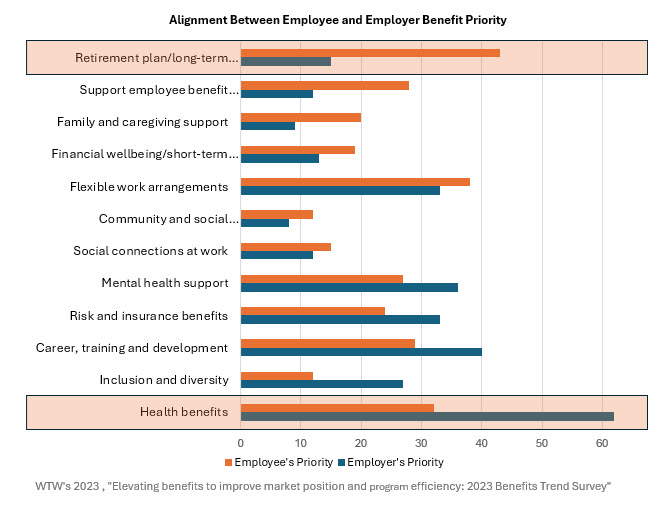
The discrepancy between employers’ and employees’ prioritization of health benefits seems surprising and contrasts with other studies , which have consistently found health insurance to be the highest-rated employee benefit—a prioritization that only increased during and after the pandemic. However, I don’t think the WTW study indicates that employees don’t want to hear about health benefits; rather, I think it points to an absence of meaningful information about retirement. In my experience, most employers discuss health benefits extensively, but they tend to leave discussions about retirement benefits to financial advisors and pension plan representatives.
I am not at all surprised by employees’ desire for information and assistance regarding “retirement plan/long-term financing.” Employers simply are not aware of this. Over the last five years, the value that employees place on retirement benefits has fluctuated wildly (which I have written about elsewhere). Employees’ prioritization of retirement benefits dipped during the pandemic years of 2020 and 2021, but since then it has increased dramatically. Employees’ endorsement of WTW’s selected phrase “retirement plan” seems to indicate that they place high value on having a plan for their retirement and future finances— not just a retirement product. Employers have not kept pace with changing employee priorities, and they may be unaware that this presents a valuable opportunity to use their current investments in benefits to better recruit and retain employees.
When recruiting and retaining employees, public-sector employers have several significant advantages over their private-sector counterparts, especially regarding retirement benefits. While 401(k) plans are well known and play an important role in helping private-sector employers recruit and retain employees, most public-sector pension systems provide an even more valuable benefit—but few public employers know how to leverage the value of their pension benefit. They might speak abstractly of how valuable it is, but I almost never hear a public employee express the excitement that they should have about the value of their pension.
This WTW study should be welcome news for most public employers. Why? Because it shows that employees are not seeking a new benefit requiring an additional investment of time and other resources. Rather, they want to be educated about their existing retirement benefit—something in which employers (and many employees) are already making significant investments. Employers need to realize that relying on the information provided by a financial advisor (who often isn’t well versed on the pension and instead focuses on investment strategies) or the pension plan representative (who focuses on the details of the pension system but not necessarily how it benefits employees) is not the best way to help employees, who long to understand the bigger picture.
Four decades spent creating software for the financial services industry have taught me that employees appreciate a high-level overview of their retirement benefits over a detailed analysis of the “nuts and bolts” of each component of their retirement. One of the best communication tools I have seen is an integrated benefit analysis, which illustrates employees’ retirement assets in the context of how much income they need. By estimating the income they need, how much they have, and any projected shortfall, an integrated benefit analysis contextualizes the funding of retirement and helps employees begin to understand the value of their pension.
Employers and employees need to be on the same page in order to appreciate the investments that are being made in benefits. When employers understand not only what type of information employees want, but also how to communicate that information to them in a meaningful way, they can leverage the value of the full benefits package to improve employee recruitment and retention.
_______________________________________________________________
[1] This includes SHRM’s annual Employee Benefit Survey, linked to above, that has consistently shown health benefits prioritized higher than other benefits.